
Sonrotoclax is a potent, and selective small-molecule inhibitor of BCL2, with a next generation mechanism of action designed to be differentiated from venetoclax through higher potency, improved selectivity, and improved binding kinetics.1,2
An ongoing Phase 1/1b study evaluating sonrotoclax + zanubrutinib in treatment-naïve CLL/SLL has reported high rates of undetectable minimal residual disease (uMRD), including patients with high-risk features.3
Sonrotoclax was designed to improve on the BCL2 inhibition of venetoclax by combining:
In the ongoing BGB-11417-101 study, sonrotoclax + zanubrutinib achieved high blood uMRD rates. In the ASH 2025 update, uMRD by Week 48 with sonrotoclax 320 mg + zanubrutinib was reported at ~92_100% across IGHV-mutated, IGHV-unmutated, and del(17p)/TP53 subgroups.3 Analysis showed rapid attainment of uMRD with median time to uMRD of 7.2 months from first zanubrutinib dose.3
Safety and efficacy have not been established for investigational products and/or uses. The clinical relevance of nonclinical data has not been established.
BCL2, B-cell lymphoma 2; CLL, chronic lymphocytic leukemia; IGHV, immunoglobulin heavy chain variable region; TP53, tumor protein 53; uMRD, undetectable minimal residual disease.
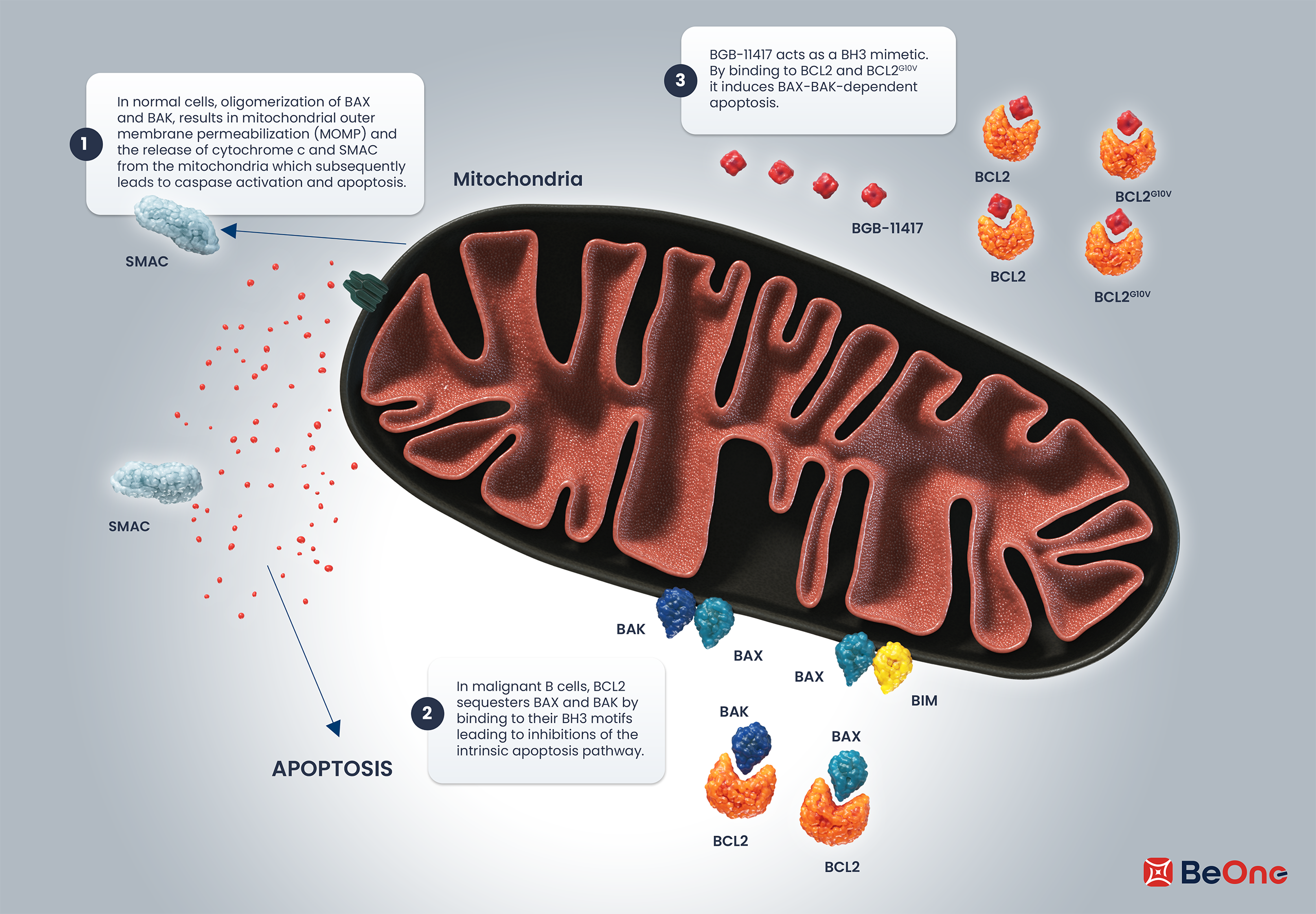
BCL2 is an anti-apoptotic protein that blocks mitochondrial apoptosis by sequestering pro-apoptotic BH3-only proteins, preventing BAX/BAK activation. In multiple B-cell malignancies, BCL2 dependence supports malignant cell survival.1,2
Acquired resistance to BCL2 inhibitors can emerge through BCL2 mutations that reduce drug binding; next-generation inhibitors are therefore being designed to maintain activity against relevant resistance variants.3,4
Sonrotoclax binds the BH3-binding groove of BCL2, displacing pro-apoptotic activators and enabling mitochondrial apoptosis.1,4 Its differentiated potency and mutant-binding profile are intended to improve apoptotic priming and maintain activity even under resistance pressure.3,4
In combination, zanubrutinib suppresses BCR-driven survival signaling while sonrotoclax directly activates mitochondrial apoptosis, providing mechanistic complementarity that is consistent with the high uMRD rates reported in the ongoing study.3-5
BAK, BCL2 antagonist/killer; BAX, BCL2-associated X; BCL2, B-cell lymphoma 2.
References
BEQALZI (sonrotoclax) is a BCL-2 inhibitor approved for the treatment of adults with relapsed or refractory mantle cell lymphoma (MCL) after at least two lines of systemic therapy, including a Bruton’s tyrosine kinase (BTK) inhibitor.
For a complete list of sonrotoclax monotherapy and combination clinical trials, view the pipeline or find a clinical trial.