




DISCLAIMER
SUMMARY
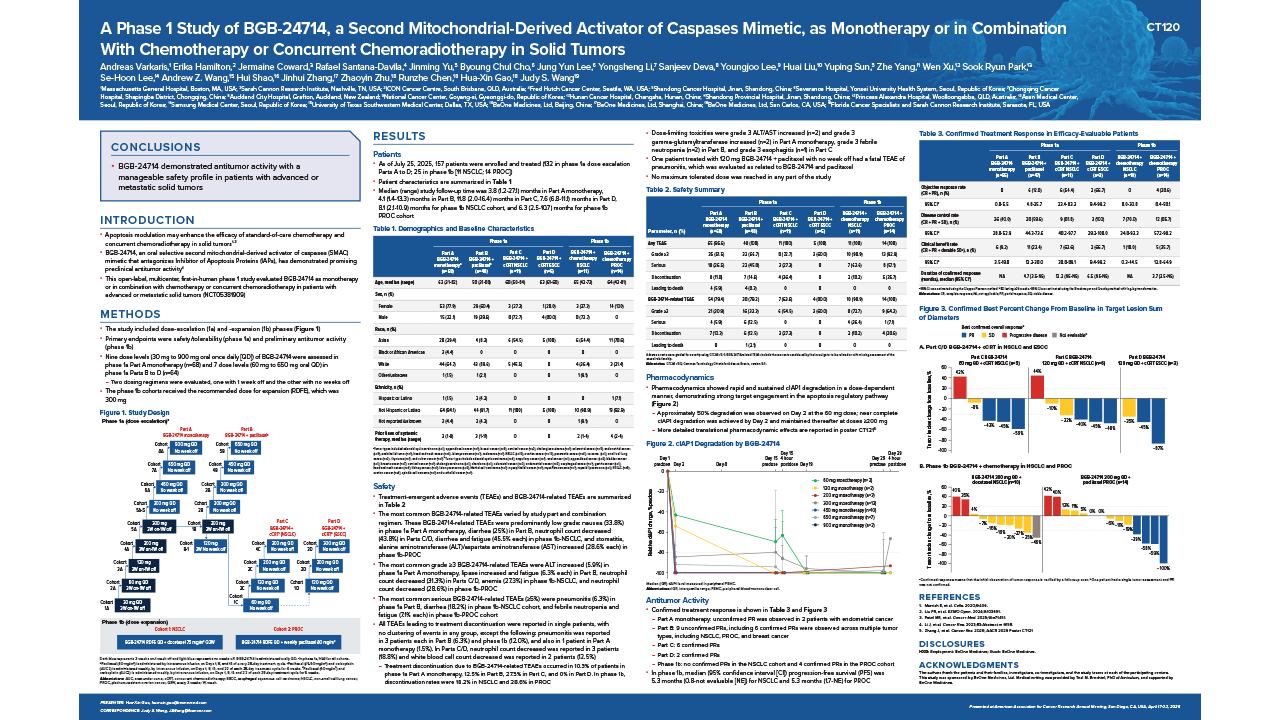
This open-label, multicenter, first-in-human phase 1 study evaluated BGB-24714, an investigational, selective second mitochondrial-derived activator of caspases (SMAC) mimetic, administered as monotherapy or in combination with chemotherapy (CT) or concurrent chemoradiotherapy (cCRT) in patients with advanced or metastatic solid tumors. The study included dose-escalation (Phase 1a) and dose-expansion (Phase 1b) cohorts, with specific tumor types targeted in each cohort. The primary endpoints were safety and tolerability in Phase 1a and preliminary antitumor activity in Phase 1b. A maximum tolerated dose was not reached. Treatment-emergent adverse events related to BGB-24714 were mostly low grade, with treatment discontinuation rates of 12.1% in Phase 1a and 24.0% in Phase 1b. Confirmed objective response rates varied from 0.0% to 66.7% in Phase 1a and from 0% to 28.6% in Phase 1b across different cohorts.
ClinicalTrials.gov ID: NCT05381909
PICO TABLE
| Population | Intervention | Comparator | Outcome Measures |
|---|---|---|---|
| Patients with advanced or metastatic solid tumors | BGB-24714 administered as monotherapy or in combination with chemotherapy or concurrent chemoradiotherapy | N/A |
|
FREQUENTLY ASKED QUESTIONS
The objective of this phase 1 study was to evaluate the safety, tolerability, and preliminary antitumor activity of BGB-24714, an investigational, selective second mitochondrial-derived activator of caspases (SMAC) mimetic, administered as monotherapy or in combination with chemotherapy or concurrent chemoradiotherapy (cCRT) in patients with advanced or metastatic solid tumors.
This open-label, multicenter, first-in-human phase 1 study included dose-escalation (Phase 1a) and dose-expansion (Phase 1b) cohorts. Phase 1a was divided into several parts: Part A evaluated BGB-24714 as monotherapy; Part B examined BGB-24714 in combination with weekly paclitaxel; and Parts C and D investigated BGB-24714 combined with cCRT for non-small cell lung cancer (NSCLC) and esophageal squamous cell carcinoma, respectively. Phase 1b enrolled patients with 2L+ metastatic NSCLC and platinum-resistant ovarian cancer (PROC), receiving BGB-24714 with either docetaxel or paclitaxel. The primary endpoints included safety and tolerability in Phase 1a, along with preliminary antitumor activity (objective response rate [ORR], disease control rate [DCR], and progression-free survival [PFS]) in Phase 1b.
As of July 25, 2025, a total of 157 patients were enrolled and treated in the study, with 132 patients in Phase 1a and 25 patients in Phase 1b (including 11 with NSCLC and 14 with PROC). In Phase 1a Part A (n=68), 9 dose levels of BGB-24714, ranging from 30 mg to 900 mg once daily (QD), were assessed. In Parts B to D of Phase 1a (n=64), 7 dose levels ranging from 60 mg to 650 mg QD were evaluated.
The most common treatment-emergent adverse events (TEAEs) related to BGB-24714 varied across study parts and were predominantly low grade. In Phase 1a Part A, nausea was reported in 33.8% of patients, while diarrhea occurred in 25% of patients in Part B. In Parts C and D, a decrease in neutrophil count was noted in 43.8% of patients. For Phase 1b, both diarrhea and fatigue were reported in 45.5% of patients with NSCLC, and stomatitis and elevated ALT/AST levels each occurred in 28.6% of patients with PROC. The most common serious BGB-24714-related TEAEs (≥5%) were pneumonitis (6.3%) in Phase 1a Part B, diarrhea (18.2%) in Phase 1b-NSCLC, and febrile neutropenia and fatigue (7.1% each) in Phase 1b-PROC. Treatment discontinuation due to treatment-related TEAEs occurred in 12.1% of phase 1a and 24.0% of phase 1b patients.
In Phase 1a, the confirmed ORRs were as follows: 0% in Part A, 12.8% in Part B, 54.5% in Part C, and 66.7% in Part D. The DCRs for these parts were 40.0%, 59.6%, 81.8%, and 100.0%, respectively. In Phase 1b, the confirmed ORR was 0% in the NSCLC cohort and 28.6% in the PROC cohort, with DCRs of 70.0% and 85.7%, respectively. The median PFS was 162 days for both the NSCLC and PROC cohorts.